


Airbus unveils concepts for zero-emission planes.
Airbus has announced plans for the world’s first hydrogen planes that could be in service by 2035.
The aircraft manufacturer on Monday released three different aircraft concepts, each exploring a different approach to achieving zero-emission flight, but all using hydrogen as a fuel.
The propulsion model involves a gas turbine combusting hydrogen in a similar manner to a jet engine. This turbine would have an electric motor, driven by fuel cells, capable of injecting power into the shaft of the turbine.
The only emissions produced when hydrogen is burned is water vapour.
“I strongly believe that the use of hydrogen – both in synthetic fuels and as a primary power source for commercial aircraft – has the potential to significantly reduce aviation’s climate impact,” Airbus CEO Guillaume Faury said.
“These concepts will help us explore and mature the design and layout of the world’s first climate-neutral, zero-emission commercial aircraft, which we aim to put into service by 2035.”
So excited to have shared our #zeroe concept aircraft with you!
Missed it? We’ve got you covered. Check this out 👇But this is only the beginning. Stay tuned for more in the weeks to come!
Learn more on our website: https://t.co/rl1CcXfsiK#ZeDay #ZeroEmissionsDay pic.twitter.com/iAMkofvz9e— Airbus (@Airbus) September 21, 2020
The first of the three concepts is a small turboprop aircraft targeting regional markets with a capacity of around 100 passengers and a range of around 1000 nautical miles.
The second concept is a narrow-body aircraft with a range of around 2,000 nautical miles. This plane will look to replace the A320 and can seat up to 200 passengers.
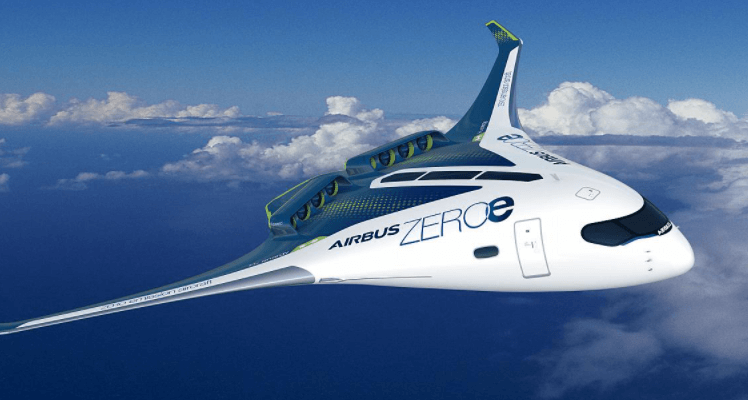
The third and final concept is described as having a “blended-wing body” that can also seat 200 passengers.
The unusual design has an exceptionally wide fuselage that creates multiple options for both hydrogen storage and distribution and cabin layout.
Airbus has dubbed the three concepts “ZEROe.”
The International Civil Aviation Organisation (ICAO) says that it is possible to meet 100 per cent of international jet fuel demand with sustainable aviation fuels by 2050.
It cautions however that “this level of fuel production could only be achieved with extremely large capital investments in sustainable aviation fuel production infrastructure,T and substantial policy support.”
 [adblockingdetector id="638efa67113bf"]