


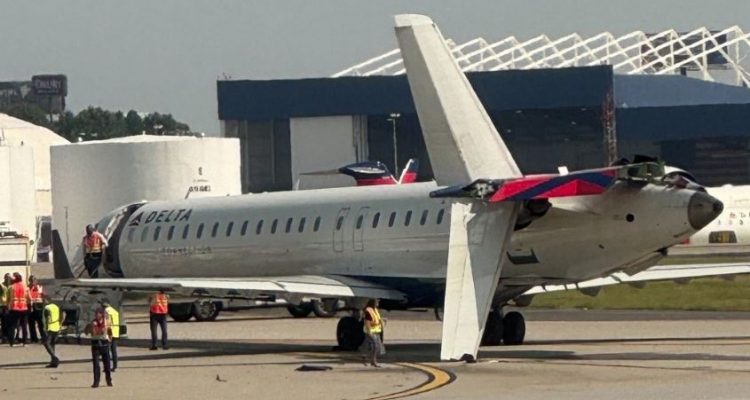
Delta plane clips smaller aircraft at Atlanta airport.
A Delta Air Lines flight bound for Tokyo was involved in a collision with a smaller jet at Hartsfield-Jackson Atlanta International Airport on Tuesday. The incident occurred while flight DL295 was taxiing for take-off, and its wingtip struck the tail of Endeavor Air Flight 5526, which was preparing to depart for Louisiana. The collision resulted in the tail of the smaller plane being completely severed, though fortunately, no injuries were reported.
According to the Federal Aviation Administration (FAA), the accident took place at approximately 10:10 am local time at the intersection of two taxi lanes. Despite the severity of the collision, airport operations remained mostly unaffected. The FAA has launched an investigation to determine the exact cause of the incident and to ensure that such events are avoided in the future.
Passengers on both planes were quickly attended to, with those on the smaller Endeavor flight being transported by bus from the site of the accident to the terminal. Meanwhile, the Delta flight managed to taxi under its own power to a concourse, where passengers were safely deplaned at the gate. Delta promptly issued a statement, assuring that affected customers were being rebooked on alternative flights to continue their journeys.
Endeavor Air, which operates regional flights for Delta as a subsidiary, confirmed that all passengers from the flight were unharmed and that measures were being taken to handle the disrupted travel schedules. This incident is the latest in a series of runway mishaps at various airports, raising concerns about safety protocols at major travel hubs.
At an industry conference on the same day, FAA Administrator Mike Whitaker addressed ongoing efforts to reduce incidents like the one at Atlanta. He acknowledged the progress made with technology designed to enhance situational awareness for air traffic controllers but admitted that improvements were still needed. Whitaker noted that close-call incidents had decreased by over 50% in the first half of the year, but emphasised that any runway collision, no matter how minor, is unacceptable.
While the Atlanta collision did not lead to serious injury or major disruption, it underscores the ongoing need for advancements in airport safety technologies and practices. The FAA’s investigation will likely yield further insights into what caused the accident and what steps can be taken to ensure it is not repeated in the future.
Earlier in the year, another potentially catastrophic event was narrowly avoided at New York’s JFK International Airport when a quick-thinking Delta pilot aborted a take-off to avoid colliding with several planes on the runway.
 [adblockingdetector id="638efa67113bf"]