


Singapore Food Guide
Food in Singapore: What to Eat & Drink
Singapore’s culinary landscape is a meticulous, hyper-diverse, and passionately obsessive expression of a global city-state. Chinese, Malay, Indian, and Peranakan traditions intersect with colonial legacies and relentless innovation to create one of the world’s most celebrated and accessible food cultures. Built on trade and immigration, Singapore developed a fiercely egalitarian food identity centered on the hawker centre as a social institution, where the pursuit of perfection in individual dishes is taken as seriously as any fine-dining craft.
Shaped by its tropical climate, strategic port location, and a multicultural society that treats food as a pillar of national identity, Singaporean cuisine celebrates chilli crab, Hainanese chicken rice, laksa, roti prata, and satay with a level of precision and pride that turns eating into a national pastime. This is a city where food is a universal language, where Michelin recognition extends to street stalls, and where every meal offers a tightly balanced snapshot of Asia’s complexity on a single plate.
Core ingredients reflect Singapore’s layered heritage. Rice, noodles, coconut milk, chillies, lemongrass, tamarind, spices, fresh seafood, and poultry form the essential foundation. Dishes are defined by bold contrasts of flavour and texture, an expert balance of spicy, sour, sweet, and savoury, and an almost scientific dedication to refining iconic recipes. As an island nation reliant on imports, Singapore has become a curator of regional ingredients and techniques, combining spotless order with explosive flavour. From a decades-old bak kut teh shop in Balestier to a boundary-pushing modern tasting menu, eating in Singapore is a democratic journey through the story of a nation told through food.
Local Specialties of Singapore
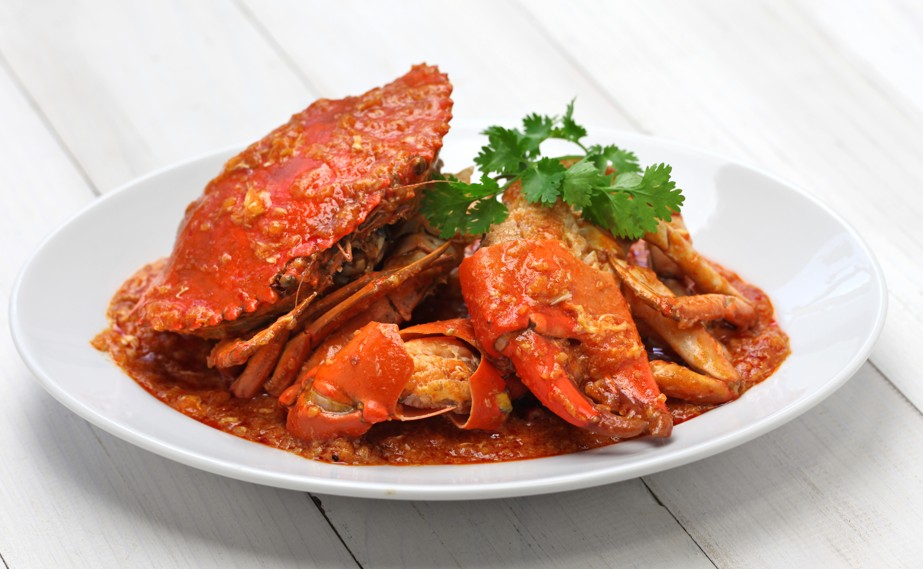
Singapore’s iconic dishes are national institutions. Chilli crab is the definitive seafood feast, featuring mud crabs stir-fried in a sweet, savoury, gently spicy tomato-chilli gravy, best enjoyed with fried mantou buns to soak up the sauce. Hainanese chicken rice is widely regarded as the national dish, pairing poached chicken served at room temperature with fragrant rice cooked in chicken stock and accompanied by chilli, ginger, and dark soy sauces.
Laksa, particularly the Katong-style version, combines coconut curry broth with noodles, cockles, fish cake, and prawns. Char kway teow is a smoky stir-fry of flat rice noodles with cockles, Chinese sausage, egg, and bean sprouts, prized for its wok hei. Hokkien mee features yellow noodles and rice vermicelli fried in a rich prawn stock. Satay consists of skewers of marinated meat grilled over charcoal and served with peanut sauce, rice cakes, and cucumber relish. Roti prata, a flaky South Indian flatbread, is dipped into curry and eaten at all hours. Bak kut teh is a peppery pork rib soup, while fish head curry is a uniquely Singaporean creation that stews an entire fish head in a tangy, spice-laden curry. Kaya toast with soft-boiled eggs and coffee remains the quintessential local breakfast.
Everyday Singapore & Hawker Culture
Breakfast is often kaya toast, soft-boiled eggs, or a quick noodle dish. Lunch is typically eaten at a hawker centre or food court, where meals are fast, affordable, and consistently high quality. Dinner may be another hawker meal, a seafood feast at a specialist restaurant, or a longer family-style meal at home.
The hawker centre is the unquestioned heart of daily life, a democratic space where people from all walks of life queue side by side for the best food. Kopitiams and modern food courts play a similar role. Dining is efficient, social, and focused almost entirely on the food itself. Local knowledge revolves around which stall does which dish best, and many stalls specialise in a single recipe perfected over decades. Eating happens around the clock, with certain foods associated with breakfast, lunch, or late-night supper. Service is fast, functional, and built for volume.
Cultural Fusion: Chinese, Malay, Indian Foundations & Peranakan Cuisine
Singapore’s cuisine rests on three primary foundations. Chinese traditions contribute noodles, soups, roasting techniques, and stir-fries from Hokkien, Teochew, Cantonese, and Hainanese communities. Malay cooking provides coconut-rich curries, grilled meats, and aromatic spice blends. Indian influences, particularly from Tamil and Muslim communities, bring breads, curries, and complex masalas.
The most distinctive fusion born in Singapore is Peranakan, or Nyonya, cuisine. Developed through generations of intermarriage between Chinese settlers and Malay women, it combines Chinese techniques with Malay ingredients and spice profiles, resulting in labour-intensive, highly nuanced dishes. This creates a uniquely Singaporean table where a Tamil banana-leaf meal, Teochew porridge, nasi lemak, and a Peranakan laksa can all coexist within a single food centre, each authentic in origin yet inseparable from Singapore’s identity.
Craft Beverage Scene and Local Libations
Singapore’s beverage culture is as layered as its food. The Singapore Sling, the iconic gin-based cocktail, was created in the early 20th century and remains a symbol of the city’s colonial past. Tiger Beer is the ubiquitous local lager and a common companion to seafood meals.
Local coffee, known as kopi, is roasted with sugar and margarine and brewed through a cloth filter, while teh refers to strong local tea. These drinks come with their own shorthand language and are part of daily ritual. Fresh sugar cane juice is a staple at hawker centres. The craft cocktail scene is world-renowned, with Singapore frequently ranking among the top global bar destinations. Craft beer continues to grow, while traditional drinks such as bandung, winter melon tea, and lime juice remain popular. What defines Singapore is the contrast between a morning kopi at a kopitiam, a cold beer with chilli crab, and an expertly crafted cocktail in a discreet rooftop bar.
International Dining and Contemporary Scene
As a global financial hub, Singapore hosts one of the world’s strongest international dining scenes, with top-tier French, Italian, Japanese, Chinese, and other cuisines represented at Michelin-star level.
Modern Singaporean cuisine, often called Mod-Sin, is a vibrant movement that reinterprets hawker classics using contemporary techniques and premium ingredients. Despite this innovation, the soul of Singapore’s food culture remains firmly rooted in its hawker centres. Fine dining and street food exist in constant dialogue, with many high-end chefs drawing inspiration from humble stalls. For visitors, this duality is unmatched: it is entirely possible to enjoy a transformative plate of chicken rice for a few dollars and a world-class tasting menu on the same day.
Food Customs and Practical Tips
Dining is casual, particularly at hawker centres. Tipping is not practiced. Seats are often reserved by placing a packet of tissues on the table, a practice known as chope. Queuing is orderly and expected, and diners are encouraged to return trays to designated collection points.
For the best experience, visit multiple hawker centres, as each has its own standout stalls. Well-known centres include Maxwell Food Centre, Old Airport Road, Chinatown Complex, and Lau Pa Sat. Long queues usually signal quality. Carry some cash, as not all stalls accept cards. Seek out stalls recognised by the Michelin Bib Gourmand for exceptional value, and be open to trying unfamiliar dishes.
Different neighbourhoods offer distinct food experiences. Chinatown blends historic hawker stalls with contemporary dining and bars. Little India is ideal for vegetarian and banana-leaf meals. Katong and Joo Chiat are the heart of Peranakan culture and laksa traditions. Geylang is famous for late-night suppers and uniquely local dishes. Try both a legendary hawker stall and a modern Singaporean restaurant, and consider joining a guided food tour to navigate the variety. Expect heat and humidity, wide price ranges, and consistently high standards. Above all, embrace Singapore’s culinary spirit: obsessive, democratic, astonishingly diverse, and proudly reflective of a society where good food is considered the greatest shared pleasure.
This guide covers what to eat in Singapore, from chilli crab and Hainanese chicken rice to laksa, satay, and enduring local classics. Use it to plan a culinary pilgrimage to the world’s undisputed hawker capital.
Check monthly weather averages for
Latest Secret Flying deals to Singapore
Non-stop from Tokyo, Japan to Singapore for only $299 USD roundtrip
Non-stop flights from Tokyo, Japan to Singapore for only $299 USD roundtrip.
View DealNon-stop from Vienna, Austria to Singapore for only €468 roundtrip
Non-stop flights from Vienna, Austria to Singapore for only €468 roundtrip.
View DealNon-stop from Chennai, India to Singapore for only $277 USD roundtrip
Non-stop flights from Chennai, India to Singapore for only $277 USD roundtrip with Singapore Airlines.
View Deal [adblockingdetector id="638efa67113bf"]