


Vienna Food Guide
Food in Vienna: What to Eat & Drink
Vienna’s culinary landscape is a grand, opulent, and nostalgically layered expression of a former imperial capital, where the courtly traditions of the Habsburg Monarchy, the influences of its vast multicultural territories, and the cozy comforts of bourgeois and working-class life converge to create a cuisine defined by heartiness, refined pastries, and an unrivaled coffeehouse culture. As the capital of the Austro-Hungarian Empire for centuries, Vienna developed a food culture that is both imperial in its elegance and gemütlich (cozy) in its everyday appeal, governed by the rhythm of café life, the rituals of Heurigen wine taverns, and a deep respect for tradition. Shaped by its position at the crossroads of Europe—absorbing influences from Hungary, Bohemia, Italy, and the Balkans—Viennese cuisine celebrates schnitzel, goulash, sausages, dumplings, and an extraordinary world of cakes, all served with formal yet welcoming service. This is a city where food is history on a plate, where the coffeehouse is a “living room for the public,” and where every meal reflects the lingering essence of Central Europe’s most storied capital.
Core ingredients like veal and pork, beef, freshwater fish (such as zander), root vegetables, cabbage, onions, paprika (from Hungarian influence), caraway, dill, sour cream, flour, eggs, butter, and poppy seeds form the foundation. Dishes are characterized by rich, savory flavors, gentle sweetness in pastries, and a mastery of frying and braising, paired with patisserie-level refinement. Vienna’s inland geography shaped a cuisine focused on preserved meats, grains, and dairy rather than seafood. Its identity is one of monumental Ringstrasse boulevards and intimate cobbled courtyards, where imperial palaces sit minutes from neighborhood Beisls. From a chandeliered Kaffeehaus to a rustic heuriger in the Vienna Woods, eating in Vienna is a delicious immersion into the soul of Mitteleuropa.
Local Specialties of Vienna
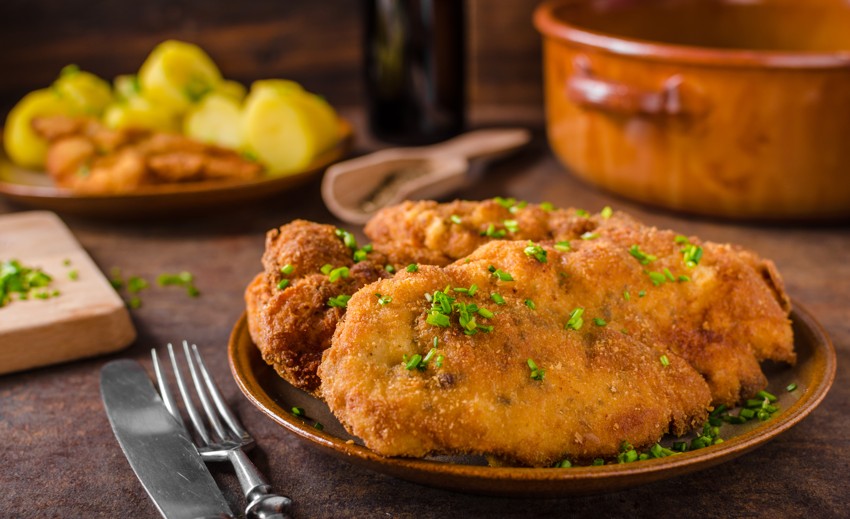
Vienna’s iconic dishes blend imperial legacy with home cooking. Wiener Schnitzel is the sacred national dish: a thin, breaded, and fried veal cutlet (pork versions are common but technically not “Wiener”), served with lemon and either potato salad or parsley potatoes. It should be crisp, airy, and large enough to cover the plate.
Tafelspitz is gently boiled prime beef served with broth, apple-horseradish, chive sauce, and root vegetables, famously favored by Emperor Franz Joseph. Wiener Gulasch is a thick, dark beef stew, milder and more concentrated than its Hungarian cousin. Beuschel is a traditional ragout of calf’s lungs and heart in a creamy sauce. Wiener Würstel—Frankfurters, Käsekrainer (with cheese), and Bratwurst—are essential street food, served at a Würstelstand with mustard and a roll.
Knödel (dumplings) appear in savory forms (bread, semolina) and sweet versions filled with apricots or plums. Kaiserschmarrn is a fluffy, torn pancake caramelized and dusted with sugar, served with plum compote. Apfelstrudel is the iconic paper-thin pastry filled with apples, cinnamon, and raisins. Sachertorte is the famous dense chocolate cake with apricot jam, invented at the Hotel Sacher. Kaffee is a culture in itself, with preparations such as Melange, Einspänner, and Fiaker.
Everyday Vienna & Austrian Food
Breakfast is typically simple: bread rolls with jam and coffee. Traditionally, lunch (Mittagessen) was the main meal, though dinner is now equally important. The afternoon coffee-and-cake ritual, usually between 3 and 5 p.m., remains sacrosanct.
The culture of the Kaffeehaus (coffeehouse), Beisl (cozy tavern), Heuriger (wine tavern serving young wine and cold buffets), and Würstelstand defines daily eating. Meals are social yet formal, with professional service that can feel brisk but is rarely unfriendly. Local drinks include Grüner Veltliner, Gemischter Satz, Zweigelt, Ottakringer beer, or simply water. The pace is unhurried—especially in a coffeehouse, where lingering for hours over a single cup is expected.
Cultural Fusion and Imperial Heritage
Viennese cuisine is fundamentally Central European, transformed by the empire’s multicultural reach. Hungarian paprika and goulash, Bohemian dumplings and pastries, Italian influences on schnitzel and coffee culture, and Balkan stews all became woven into a single culinary identity.
The imperial court’s demand for refinement elevated rustic dishes and produced one of Europe’s great pastry traditions. The result is a table where farmer’s food, court cuisine, and café elegance coexist seamlessly.
Drinks and Coffeehouse Culture
Vienna’s beverage culture rests on two pillars: coffee and wine. Viennese coffeehouse culture is UNESCO-listed, with elaborate drinks served on a silver tray with a glass of water. The Kaffeehaus functions as a social hub, workplace, and refuge.
Viennese wine is a local treasure, grown within the city limits in districts like Grinzing and Nussberg. Crisp whites (especially Gemischter Satz) and light reds are best enjoyed at a Heuriger. Sturm, a partially fermented young wine, appears in early autumn. Most (apple or pear cider) and Schnaps (fruit brandy) are also common. What distinguishes Vienna is the seamless transition from an afternoon Melange in a grand café to an evening among vineyards drinking wine made just beyond the tram line.
International Dining and Contemporary Vienna
As a modern capital, Vienna offers excellent international dining, from refined French and Italian restaurants to outstanding Balkan, Turkish, and Vietnamese cuisine reflecting its contemporary diversity.
Neue Wiener Küche (New Viennese Cuisine) reinterprets classic dishes with lighter techniques and global inspiration, earning the city numerous Michelin stars. Still, the heart of Viennese food culture remains in historic coffeehouses, traditional Beisls, and Heurigen, where continuity and ritual matter as much as innovation.
Food Customs and Practical Tips
Dress neatly for coffeehouses and traditional restaurants. Tipping is customary: round up small bills or add about 5–10% for table service, stating the total you wish to pay. In a coffeehouse, your table is yours for as long as you like.
For an authentic experience, enjoy cake and coffee in a historic Kaffeehaus such as Café Central, Sacher, or Demel. Visit a Heuriger in the 19th district (Grinzing or Neustift) for wine and cold dishes. Dine at a traditional Beisl for Tafelspitz or Gulasch. Grab a late-night sausage from a Würstelstand. Never pour sauce over a Wiener Schnitzel; lemon is all it needs.
Explore different areas: Innere Stadt for grand cafés and historic restaurants; Neubau and Josefstadt for traditional Beisls and contemporary spots; Naschmarkt for produce and international food; and the Vienna Woods for Heurigen. Vienna rewards patience and tradition. Above all, embrace its culinary spirit: gemütlich, historic, proudly traditional yet quietly evolving—a true taste of imperial elegance and Central European soul.
This guide covers what to eat in Vienna, Austria, from Wiener Schnitzel and Sachertorte to Kaffeehaus culture, Gulasch, and classic Viennese dishes. Use it to plan your culinary journey through the heart of the Habsburg legacy.

 [adblockingdetector id="638efa67113bf"]