


Warsaw Food Guide
Food in Warsaw: What to Eat & Drink
Warsaw’s culinary landscape is a hearty, resilient, and dynamically evolving expression of Poland’s spirit, where nobleman’s feasts, wartime scarcity, socialist-era pragmatism, and a post-millennium boom converge to create a cuisine defined by its comforting flavors, mastery of fermentation, and an unstoppable drive for reinvention. As a phoenix city risen from the ashes of war, Warsaw developed a food culture that is fiercely proud of its traditions yet eagerly cosmopolitan, governed by the rhythm of the seasons, the legacy of the manor house (dwór), and the vibrant pulse of a capital catching up with Europe. Shaped by its multi-ethnic past (Jewish, Ukrainian, Lithuanian), its position at the crossroads of Central Europe, and the recent influx of global influences, Polish cuisine in Warsaw is a celebration of rye bread, pork, cabbage, potatoes, mushrooms, dairy, and dill, all served with generous hospitality and an increasingly creative edge. This is a city where food is history and hope on a plate, where the milk bar is a living monument, and where every meal—from a humble pickle soup to a modern tasting menu—is an opportunity to taste the defiant joy and sophistication of modern Poland.
Core ingredients like rye (for essential sourdough bread), pork in all forms, chicken, duck, freshwater fish, cabbage (fresh and fermented as sauerkraut), beets, potatoes, mushrooms (both wild and cultivated), cucumbers (pickled), dill, marjoram, caraway, horseradish, sour cream, twaróg (farmer’s cheese), and seasonal berries and apples form the foundation. Dishes are characterized by hearty, savory, sour, and subtly sweet profiles, a mastery of slow-cooking, braising, and fermentation, and a satisfying balance between rustic comfort and modern refinement. Warsaw’s history of near-total destruction and deliberate rebuilding created a dining culture that simultaneously clings to tradition and embraces the new. Its identity is one of painstakingly reconstructed Old Town squares and gleaming skyscrapers, where socialist-era milk bars sit next to Michelin-starred restaurants. From a neon-lit bar mleczny to a sleek restaurant in a converted pre-war townhouse, eating in Warsaw is a compelling immersion into a nation on the move.
Local Specialties of Warsaw
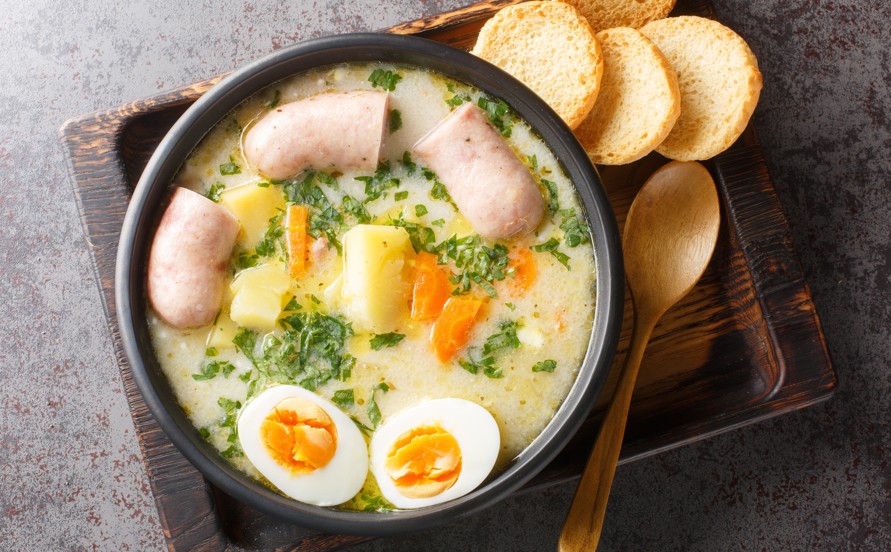
Warsaw’s iconic dishes are a mix of national staples and local classics. Żurek is the signature sour rye soup, often served in a bread bowl with a hard-boiled egg and white sausage (biała kiełbasa), sometimes enriched with smoked bacon.
Barszcz czerwony is the clear, vibrant beetroot soup, often served with uszka (tiny dumplings). Pierogi are Poland’s beloved dumplings, with fillings like minced meat and onions (z mięsem), sauerkraut and wild mushrooms (z kapustą i grzybami), potato and cheese (ruskie), or sweet blueberries.
Kotlet schabowy is the Polish breaded pork cutlet—thicker than a Viennese schnitzel—usually served with mashed potatoes and a cabbage salad. Bigos (Hunter’s Stew) is a slow-cooked masterpiece of sauerkraut, fresh cabbage, assorted meats, sausages, and dried mushrooms, famously even better the next day.
Placki ziemniaczane are crisp potato pancakes, served with sour cream or topped with goulash. Pyzy and kluski śląskie are potato dumplings that often appear as sides. Pączki are the legendary jam-filled doughnuts, especially popular on Fat Thursday. Wuzetka is a classic Warsaw chocolate-and-cream layer cake, named after the W-Z Route. Ogórek kiszony and other kiszonki (fermented vegetables) are ever-present at the table, reinforcing the city’s love of sour, briny brightness.
Everyday Warsaw & Polish Food
Breakfast is often open-faced sandwiches (kanapki) on rye bread with cold cuts, cheese, and vegetables. Lunch (obiad) is traditionally the main, substantial meal of the day, commonly built around soup followed by a meat-and-potatoes main, finished with kompot (fruit drink) or tea. Dinner can be lighter, though modern schedules have made evening dining increasingly prominent.
The culture of the bar mleczny (milk bar—subsidized, no-frills cafeterias serving traditional Polish food), the kawiarnia (café for pastries and socializing), the restauracja, and the bazar (market) is central. Eating is family-oriented and social, and the compliment domowy (“homemade”) is the highest praise. Meals are frequently accompanied by tea, beer, or kompot. Service has evolved from the stereotypically brisk to increasingly professional, especially in the city’s modern restaurant scene, but the café pace remains pleasantly unhurried.
Cultural Fusion: Slavic Roots, Commonwealth Diversity & Modern Globalism
Polish cuisine’s foundation is Slavic and agrarian—rye, cabbage, pork, dairy, and preserved foods—yet it was enriched by the multicultural Polish-Lithuanian Commonwealth and centuries of exchange. Jewish, Lithuanian, Ukrainian, German, and other influences shaped dumplings, breads, festive dishes, and seasoning practices, while trade routes introduced spices and new techniques.
The partitions, wars, and socialist period emphasized survival and simplicity, preserving the core of the cuisine through canteens and home kitchens. After 1989, Warsaw experienced a dramatic reopening: regional traditions were rediscovered, manor-house (staropolska) recipes revived, and global influences integrated. The result is a city where you can taste peasant-era sour soups, celebratory bigos, Jewish culinary echoes, and contemporary chef-driven interpretations of beetroot, forest herbs, and fermented grains.
Craft Beverage Scene and Local Libations
Warsaw’s beverage scene is booming, led by a serious craft beer revolution. Craft piwo is a passion, with taprooms and bars pouring everything from clean lagers to barrel-aged stouts.
Wódka (vodka) remains the national spirit, served chilled and straight, with premium bottlings and beloved flavored styles such as żubrówka (bison grass) and wiśniówka (cherry). Miód pitny (mead) is enjoying a stylish revival, while fruit brandies like śliwowica appear as potent digestifs. Kawa (coffee) culture is strong and modern, with third-wave cafés now a core part of daily life. Kompot remains the comfort-forward, homemade non-alcoholic classic. What distinguishes Warsaw is the ease with which a night can move from a cutting-edge craft beer bar to a distinctly Polish, ritual shot of vodka—traditional and modern in a single arc.
International Dining and Contemporary Scene
As a rapidly internationalizing capital, Warsaw has an increasingly impressive range of global cuisines. Vietnamese (a longstanding diaspora), Georgian, Italian, Japanese, and Middle Eastern restaurants are prominent, reflecting the city’s modern demographics and appetite for variety.
Modern Polish fine dining is one of Warsaw’s major strengths, with ambitious kitchens reinterpreting national ingredients—wild mushrooms, forest berries, fermented grains, smoked fish, heritage meats—through contemporary technique. Yet the city’s soul remains in its milk bars, bustling food halls, and cozy pierogarnias where value, nostalgia, and real comfort dominate. For visitors, the duality is the thrill: a filling, historic meal for a modest price, followed by a sophisticated tasting menu that rivals Europe’s best.
Food Customs and Practical Tips
Dining is generally casual, but dress smart-casual for upscale restaurants. Tipping (around 10%) is customary in restaurants. When invited to a home, it’s polite to bring flowers (an odd number) or wine. Bread matters—try it, and don’t waste it.
For an authentic experience, have lunch at a bar mleczny for classic, affordable Polish home cooking. Try zapiekanka (a toasted open-faced baguette with toppings) as an iconic late-night snack. Visit a food hall such as Hala Koszyki or Norblin for a cross-section of modern Warsaw eating. Go to a “pijalnia wódki i piwa” for the no-frills, communal shot-and-beer culture. Don’t only eat in the Old Town—venture to neighborhoods like Powiśle, Praga, or Mokotów for more local, innovative options.
Explore different areas: Śródmieście/Powiśle for milk bars, fine dining, and high-quality cafés; Praga (across the river) for edgier bars and creative restaurants; Nowy Świat/Krakowskie Przedmieście for historic cafés and central, walkable options. Try both a classic milk bar and a modern Polish tasting menu to feel the city’s full range. Expect hearty portions and excellent value compared to many European capitals. Most importantly, embrace Warsaw’s culinary spirit: it is resilient, generous, proudly Polish yet outward-looking, and driven by an energy that makes every meal feel like part of the city’s ongoing reinvention.
This guide covers what to eat in Warsaw, Poland, from Żurek and Pierogi to Kotlet Schabowy, Bigos, and modern Polish fine dining. Use it to plan your culinary journey to the defiant heart of Poland.
Check monthly weather averages for
Latest Secret Flying deals to Warsaw
Non-stop from Phu Quoc, Vietnam to Warsaw, Poland for only $189 USD one-way
Non-stop flights from Phu Quoc, Vietnam to Warsaw, Poland for only $189 USD one-way with LOT Polish Airlines.
View Deal🔥 Chiang Mai, Thailand to European cities from only $176 USD one-way
Cheap flights from Chiang Mai, Thailand to European cities from only $176 USD one-way with Etihad Airways.
View DealSydney, Australia to Warsaw, Poland for only $1158 AUD roundtrip
Cheap flights from Sydney, Australia to Warsaw, Poland for only $1158 AUD roundtrip with Turkish Airlines.
View Deal [adblockingdetector id="638efa67113bf"]