


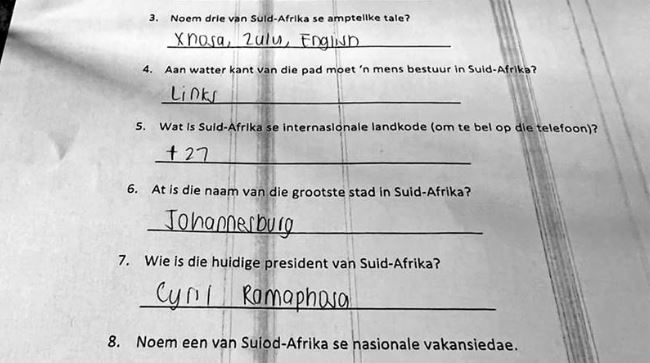
Ryanair accused of discrimination for forcing Afrikaans test.
Ryanair has been accused of racial discrimination for making South African nationals take a general knowledge test in Afrikaans to prove their nationality before being allowed to board its flights in the UK and the rest of Europe.
Despite Afrikaans being only the third most-spoken language in the country, and its history of enforced use under apartheid, the low-cost carrier said the test would apply to any South African passport holder flying to the UK.
“If they are unable to complete this questionnaire, they will be refused travel and issued with a full refund,” a spokesman for the airline said.
Ryanair said the tests had been prompted by cases of fake passports but was not an official UK requirement.
The South African government raised concerns over an alleged spate of ID fraud, saying criminals were easily manufacturing and selling fake South African passports.
However, many South Africans questioned the content of the test, saying topics including which side of the road South Africans drive on would not determine whether someone was a genuine passport holder.
The 15-question test also reportedly contains grammatical and spelling errors.
One South African passenger told the Financial Times that Ryanair’s test was “extremely exclusionary” and said the airline had not considered the implications of the test given that black South Africans were forced to use Afrikaans during the apartheid regime.
“It definitely does amount to indirect racial discrimination,” they said.
A Twitter user also accused Ryanair of racism, saying the airline was “restricting the movement of South African people based on whether or not they speak the language of the white Afrikaans minority. Not a good look. Pretty racist.”
Nomfundo Dlamini, a South African in the UK who said she was also given the test alongside colleagues, told a South African radio station that Ryanair’s policy was “Apartheid 2.0 . . . further oppression, further discrimination.”
Afrikaans is a Dutch-based language developed by many of the country’s white settlers who came from the Netherlands and is associated with South Africa’s apartheid regime of white minority rule that ended in 1994.
 [adblockingdetector id="638efa67113bf"]